Technology advisory built for what comes next.
ISG integrates advisory, benchmarking, governance and research so your technology investments perform from day one.
WHY ISG?
$200B
of technology spend influenced annually
1500
global professionals inover 20 countries
98%
of our clients recommend us
Your AI strategy, from foundation to full scale.
The gap between AI ambition and AI results is rarely a technology problem.
ISG brings the strategy, governance, commercial rigour and market intelligence that turn AI investment into measurable outcomes.
AI Strategy
AI Strategy grounded in 1,200 enterprise use cases, so leadership teams can align investment to where impact is most achievable and move from isolated pilots to commercial results.
Learn MoreAI Governance
Governance frameworks that embed controls at the point of execution, so enterprises can scale AI faster without trading spend for accountability.
Learn MoreAI & Software Intelligence
Independent intelligence drawn from $2.6 billion in tracked AI spend, so procurement, technology and finance leaders can make sharper build-versus-buy decisions and hold providers accountable to measurable outcomes.
Learn MoreAutonomy-Level Pricing
Commercial structures that reflect how AI-enabled services are actually delivered, so pricing evolves alongide capability and both buyers and providers can quantify the value of advancing AI maturity.
Learn MoreAI Maturity Index
The AI Maturity Index is a benchmarked, bottom-up strategic roadmap that gives enterprises a clear, actionable path to systematically build and scale AI capabilities across the organization.
Learn MoreFrom Generic to Genius: Industry Cloud Platforms Explained
Nov 20, 2025, 17:12
Title :
From Generic to Genius: Industry Cloud Platforms Explained
Alternate title :
Summary :
The global industry cloud platform market in 2023 was valued at $68.5 billion. It is forecasted to grow at a CAGR of 17.5% through 2032. Why are industry cloud platforms becoming so popular?
External URL :
Show date :
No
Hide Table of Contents menu :
No
Public date :
Nov 20, 2025, 01:00
Why Industry Cloud Platforms Are Exploding
The global industry cloud platform market in 2023 was valued at $68.5 billion. It is forecasted to grow at a CAGR of 17.5% through 2032. Why are industry cloud platforms becoming so popular?
Traditional “one size fits all” cloud models are reaching their limits as industries become more complex and regulatory demands intensify. Industry clouds represent the next frontier in cloud evolution—they are purpose-built, compliant and deeply integrated with the operational DNA of a specific sector. Whether it’s a healthcare provider navigating patient data privacy, a bank managing compliance under global financial standards or a manufacturer optimizing digital supply chains, the demand for tailored cloud platforms has never been more urgent—or more promising.
These platforms offer built-in compliance, tailored data models and pre-integrated applications that speed up deployment and accelerate time to value. Their ability to seamlessly integrate with existing legacy systems and modern digital ecosystems is vital in sectors such as healthcare, finance and manufacturing, where fragmentation can stifle innovation and compliance.
The stakes are high: early adopters are gaining speed, agility and competitive edge, while laggards risk falling behind in operational efficiency and market relevance. As generative AI, IoT and advanced analytics reshape industries, the ability of industry clouds to blend technology with sector expertise will define the next wave of digital transformation.
For decision-makers, the mandate is clear — invest now to lead tomorrow. But realizing this vision demands more than technology; it calls for an ecosystem of partners, skills and accelerators to succeed.
Why Generic Cloud Solutions Fall Short in Today’s Complex Market
The public cloud market has expanded at an unprecedented pace, driven by demands for faster time-to-market, automation, seamless integration and emerging innovations like generative AI. According to the ISG Market Lens™ Cloud Managed Services Study, more than 50% of application categories were in the cloud in 2024, compared with just 23% in 2022. Yet, as adoption accelerates, a growing number of enterprises are recognizing the limitations of generic, one-size-fits-all cloud platforms in addressing the realities of today’s industry landscapes.
Highly regulated and operationally complex sectors face three persistent challenges:
Regulatory gaps: Generic cloud solutions often lack built-in, sector-specific compliance frameworks to address stringent requirements such as HIPAA in healthcare, Basel III in banking or ISO standards in manufacturing.
Interoperability barriers: Integrating with fragmented legacy systems, specialized applications and multi-vendor ecosystems can be cumbersome, slowing transformation and creating operational silos.
Lack of domain fit: Generic architectures rarely align with the unique data models, workflows and performance demands of specific industries, leading to costly customizations and delayed value realization.
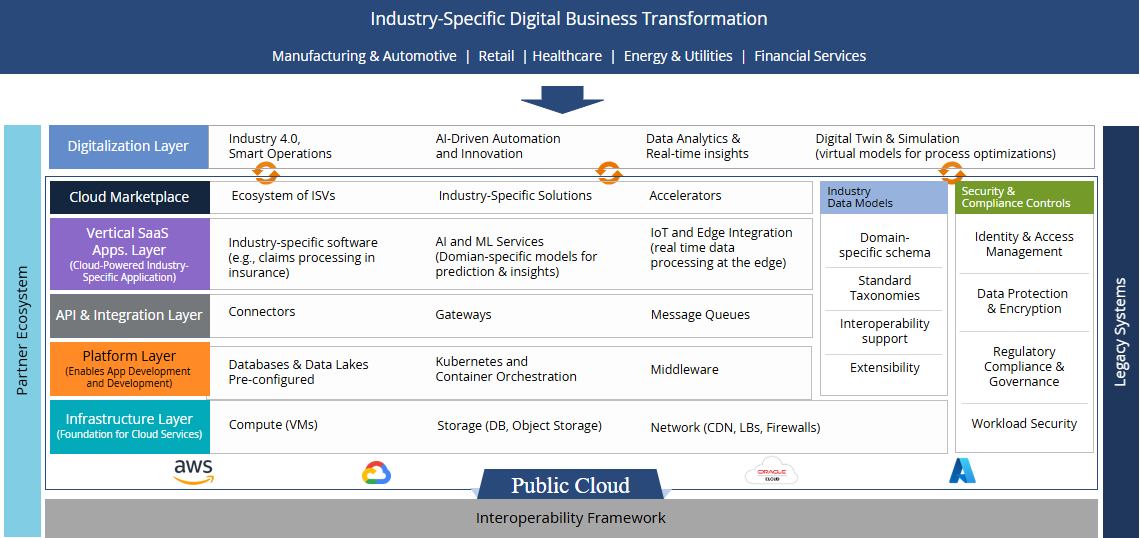
These limitations have accelerated the shift toward industry cloud platforms. Industry cloud platforms are cloud solutions designed specifically for the needs of a single industry. They combine general cloud capabilities with industry-specific applications, data models and compliance features, while embedding modern technologies like AI, analytics and automation. Built on standard cloud infrastructure, industry cloud platforms connect seamlessly with core enterprise systems—such as finance, supply chain and HR—so organizations can innovate faster, meet regulatory requirements more easily and adapt quickly to change across their value chain.
These platforms offer flexible architectures that support the high-volume data demands of connected devices, sensors and production systems. The adoption of Industry 4.0 technologies—including AI, edge, IoT and predictive analytics—further underscores the need for cloud platforms that deliver enhanced connectivity, interoperability and automation.
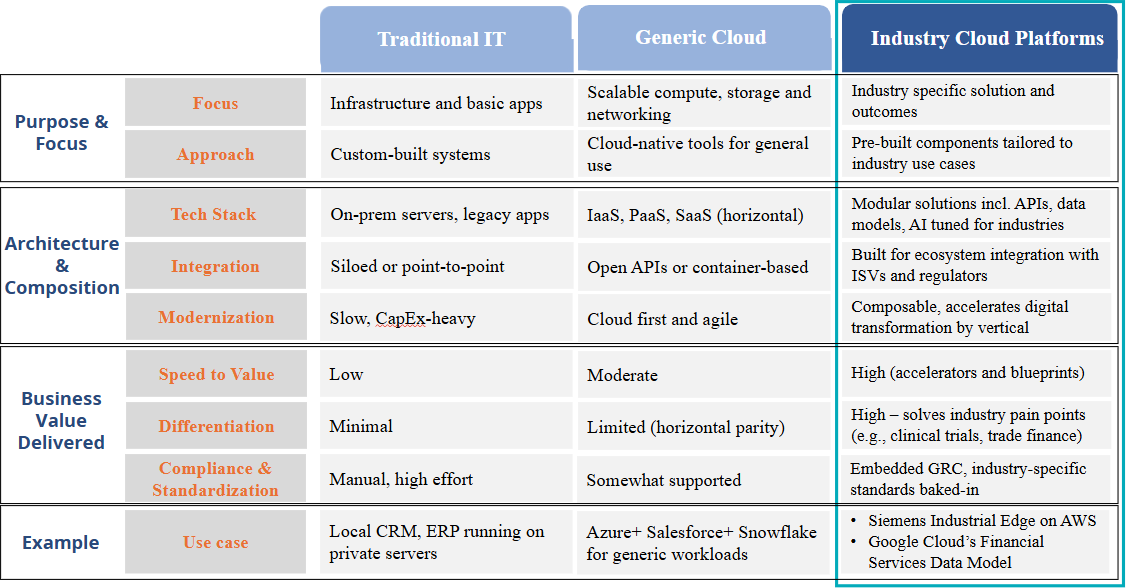
Figure 1: The Differences: Traditional IT vs. Generic Cloud vs. Industry Cloud Platforms
Facing Industry Pressures? Here’s Why Sectors Need a Specialized Cloud Approach
Different industries face different key challenges in today’s technology-enabled landscape. Many of these challenges are linked to how their legacy systems and cloud systems integrate or fail to integrate. Here are some examples of those industry-specific challenges:
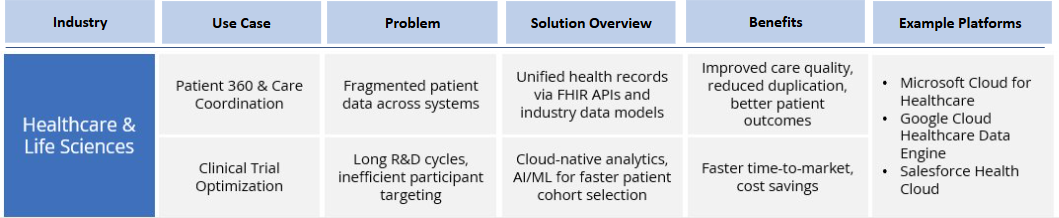
Healthcare and Life Sciences: Disconnected EHR systems, strict data privacy laws, poor interoperability and rising demand for cost-efficient, personalized care
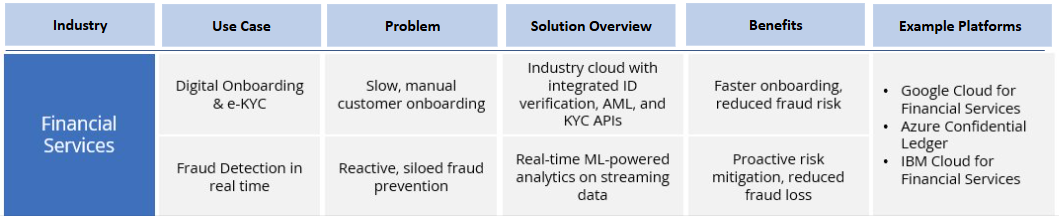
Financial Services: Heavy compliance burdens (e.g., Basel III, MiFID II, PCI-DSS), legacy systems slowing innovation, escalating cyber/fraud risks and the push for real-time, AI-driven insights
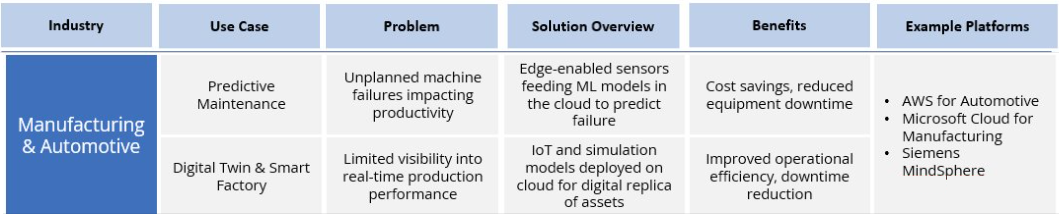
Manufacturing and Automative: Supply chain fragility, weak IT–OT integration, sustainability mandates and shortage of Industry 4.0-ready skills
Retail and consumer goods: Need for personalized, real-time engagement, volatile supply chains, fierce digital competition and omnichannel integration challenges
Public Sector and government: Data sovereignty rules, outdated infrastructure, high security/compliance demands and budget constraints limiting modernization
Telecommunications: High 5G deployment costs, complex OSS/BSS systems, network performance issues and pressure for rapid service innovation
Energy and Utilities: Aging grids, fluctuating demand, environmental compliance pressures and need for real-time asset monitoring
Education: Unequal tech access, student/staff data privacy, fragmented digital learning tools and growing cybersecurity risks
Media and entertainment: Low-latency content delivery, piracy and IP threats, multi-channel monetization challenges and demand for AI-driven personalization
These sector challenges highlight the limitations of generic cloud platforms and underscore the strategic role of industry cloud platforms in addressing compliance, interoperability and operational complexity.
Discover the Power of Industry-Specific Clouds Built for Compliance and Efficiency
Key technology components that power industry cloud platforms can enable them to meet sector-specific needs with scalability, compliance and interoperability. Some of these components include:

Categories :
- Cloud ERP
- Healthcare
Tags :
Article flags :
Service line :
Campaign :
Vertical :

Authors
Related articles
Related team members
From Generic to Genius: Industry Cloud Platforms Explained
Nov 20, 2025, 17:12
Title :
From Generic to Genius: Industry Cloud Platforms Explained
Alternate title :
Summary :
The global industry cloud platform market in 2023 was valued at $68.5 billion. It is forecasted to grow at a CAGR of 17.5% through 2032. Why are industry cloud platforms becoming so popular?
External URL :
Show date :
No
Hide Table of Contents menu :
No
Public date :
Nov 20, 2025, 01:00
Why Industry Cloud Platforms Are Exploding
The global industry cloud platform market in 2023 was valued at $68.5 billion. It is forecasted to grow at a CAGR of 17.5% through 2032. Why are industry cloud platforms becoming so popular?
Traditional “one size fits all” cloud models are reaching their limits as industries become more complex and regulatory demands intensify. Industry clouds represent the next frontier in cloud evolution—they are purpose-built, compliant and deeply integrated with the operational DNA of a specific sector. Whether it’s a healthcare provider navigating patient data privacy, a bank managing compliance under global financial standards or a manufacturer optimizing digital supply chains, the demand for tailored cloud platforms has never been more urgent—or more promising.
These platforms offer built-in compliance, tailored data models and pre-integrated applications that speed up deployment and accelerate time to value. Their ability to seamlessly integrate with existing legacy systems and modern digital ecosystems is vital in sectors such as healthcare, finance and manufacturing, where fragmentation can stifle innovation and compliance.
The stakes are high: early adopters are gaining speed, agility and competitive edge, while laggards risk falling behind in operational efficiency and market relevance. As generative AI, IoT and advanced analytics reshape industries, the ability of industry clouds to blend technology with sector expertise will define the next wave of digital transformation.
For decision-makers, the mandate is clear — invest now to lead tomorrow. But realizing this vision demands more than technology; it calls for an ecosystem of partners, skills and accelerators to succeed.
Why Generic Cloud Solutions Fall Short in Today’s Complex Market
The public cloud market has expanded at an unprecedented pace, driven by demands for faster time-to-market, automation, seamless integration and emerging innovations like generative AI. According to the ISG Market Lens™ Cloud Managed Services Study, more than 50% of application categories were in the cloud in 2024, compared with just 23% in 2022. Yet, as adoption accelerates, a growing number of enterprises are recognizing the limitations of generic, one-size-fits-all cloud platforms in addressing the realities of today’s industry landscapes.
Highly regulated and operationally complex sectors face three persistent challenges:
Regulatory gaps: Generic cloud solutions often lack built-in, sector-specific compliance frameworks to address stringent requirements such as HIPAA in healthcare, Basel III in banking or ISO standards in manufacturing.
Interoperability barriers: Integrating with fragmented legacy systems, specialized applications and multi-vendor ecosystems can be cumbersome, slowing transformation and creating operational silos.
Lack of domain fit: Generic architectures rarely align with the unique data models, workflows and performance demands of specific industries, leading to costly customizations and delayed value realization.
These limitations have accelerated the shift toward industry cloud platforms. Industry cloud platforms are cloud solutions designed specifically for the needs of a single industry. They combine general cloud capabilities with industry-specific applications, data models and compliance features, while embedding modern technologies like AI, analytics and automation. Built on standard cloud infrastructure, industry cloud platforms connect seamlessly with core enterprise systems—such as finance, supply chain and HR—so organizations can innovate faster, meet regulatory requirements more easily and adapt quickly to change across their value chain.
These platforms offer flexible architectures that support the high-volume data demands of connected devices, sensors and production systems. The adoption of Industry 4.0 technologies—including AI, edge, IoT and predictive analytics—further underscores the need for cloud platforms that deliver enhanced connectivity, interoperability and automation.
Figure 1: The Differences: Traditional IT vs. Generic Cloud vs. Industry Cloud Platforms
Facing Industry Pressures? Here’s Why Sectors Need a Specialized Cloud Approach
Different industries face different key challenges in today’s technology-enabled landscape. Many of these challenges are linked to how their legacy systems and cloud systems integrate or fail to integrate. Here are some examples of those industry-specific challenges:
Healthcare and Life Sciences: Disconnected EHR systems, strict data privacy laws, poor interoperability and rising demand for cost-efficient, personalized care
Financial Services: Heavy compliance burdens (e.g., Basel III, MiFID II, PCI-DSS), legacy systems slowing innovation, escalating cyber/fraud risks and the push for real-time, AI-driven insights
Manufacturing and Automative: Supply chain fragility, weak IT–OT integration, sustainability mandates and shortage of Industry 4.0-ready skills
Retail and consumer goods: Need for personalized, real-time engagement, volatile supply chains, fierce digital competition and omnichannel integration challenges
Public Sector and government: Data sovereignty rules, outdated infrastructure, high security/compliance demands and budget constraints limiting modernization
Telecommunications: High 5G deployment costs, complex OSS/BSS systems, network performance issues and pressure for rapid service innovation
Energy and Utilities: Aging grids, fluctuating demand, environmental compliance pressures and need for real-time asset monitoring
Education: Unequal tech access, student/staff data privacy, fragmented digital learning tools and growing cybersecurity risks
Media and entertainment: Low-latency content delivery, piracy and IP threats, multi-channel monetization challenges and demand for AI-driven personalization
These sector challenges highlight the limitations of generic cloud platforms and underscore the strategic role of industry cloud platforms in addressing compliance, interoperability and operational complexity.
Discover the Power of Industry-Specific Clouds Built for Compliance and Efficiency
Key technology components that power industry cloud platforms can enable them to meet sector-specific needs with scalability, compliance and interoperability. Some of these components include:
Categories :
- Cloud ERP
- Healthcare
Tags :
Article flags :
Service line :
Campaign :
Vertical :
Authors
Related articles
Related team members
From Generic to Genius: Industry Cloud Platforms Explained
Nov 20, 2025, 17:12
Title :
From Generic to Genius: Industry Cloud Platforms Explained
Alternate title :
Summary :
The global industry cloud platform market in 2023 was valued at $68.5 billion. It is forecasted to grow at a CAGR of 17.5% through 2032. Why are industry cloud platforms becoming so popular?
External URL :
Show date :
No
Hide Table of Contents menu :
No
Public date :
Nov 20, 2025, 01:00
Why Industry Cloud Platforms Are Exploding
The global industry cloud platform market in 2023 was valued at $68.5 billion. It is forecasted to grow at a CAGR of 17.5% through 2032. Why are industry cloud platforms becoming so popular?
Traditional “one size fits all” cloud models are reaching their limits as industries become more complex and regulatory demands intensify. Industry clouds represent the next frontier in cloud evolution—they are purpose-built, compliant and deeply integrated with the operational DNA of a specific sector. Whether it’s a healthcare provider navigating patient data privacy, a bank managing compliance under global financial standards or a manufacturer optimizing digital supply chains, the demand for tailored cloud platforms has never been more urgent—or more promising.
These platforms offer built-in compliance, tailored data models and pre-integrated applications that speed up deployment and accelerate time to value. Their ability to seamlessly integrate with existing legacy systems and modern digital ecosystems is vital in sectors such as healthcare, finance and manufacturing, where fragmentation can stifle innovation and compliance.
The stakes are high: early adopters are gaining speed, agility and competitive edge, while laggards risk falling behind in operational efficiency and market relevance. As generative AI, IoT and advanced analytics reshape industries, the ability of industry clouds to blend technology with sector expertise will define the next wave of digital transformation.
For decision-makers, the mandate is clear — invest now to lead tomorrow. But realizing this vision demands more than technology; it calls for an ecosystem of partners, skills and accelerators to succeed.
Why Generic Cloud Solutions Fall Short in Today’s Complex Market
The public cloud market has expanded at an unprecedented pace, driven by demands for faster time-to-market, automation, seamless integration and emerging innovations like generative AI. According to the ISG Market Lens™ Cloud Managed Services Study, more than 50% of application categories were in the cloud in 2024, compared with just 23% in 2022. Yet, as adoption accelerates, a growing number of enterprises are recognizing the limitations of generic, one-size-fits-all cloud platforms in addressing the realities of today’s industry landscapes.
Highly regulated and operationally complex sectors face three persistent challenges:
Regulatory gaps: Generic cloud solutions often lack built-in, sector-specific compliance frameworks to address stringent requirements such as HIPAA in healthcare, Basel III in banking or ISO standards in manufacturing.
Interoperability barriers: Integrating with fragmented legacy systems, specialized applications and multi-vendor ecosystems can be cumbersome, slowing transformation and creating operational silos.
Lack of domain fit: Generic architectures rarely align with the unique data models, workflows and performance demands of specific industries, leading to costly customizations and delayed value realization.
These limitations have accelerated the shift toward industry cloud platforms. Industry cloud platforms are cloud solutions designed specifically for the needs of a single industry. They combine general cloud capabilities with industry-specific applications, data models and compliance features, while embedding modern technologies like AI, analytics and automation. Built on standard cloud infrastructure, industry cloud platforms connect seamlessly with core enterprise systems—such as finance, supply chain and HR—so organizations can innovate faster, meet regulatory requirements more easily and adapt quickly to change across their value chain.
These platforms offer flexible architectures that support the high-volume data demands of connected devices, sensors and production systems. The adoption of Industry 4.0 technologies—including AI, edge, IoT and predictive analytics—further underscores the need for cloud platforms that deliver enhanced connectivity, interoperability and automation.
Figure 1: The Differences: Traditional IT vs. Generic Cloud vs. Industry Cloud Platforms
Facing Industry Pressures? Here’s Why Sectors Need a Specialized Cloud Approach
Different industries face different key challenges in today’s technology-enabled landscape. Many of these challenges are linked to how their legacy systems and cloud systems integrate or fail to integrate. Here are some examples of those industry-specific challenges:
Healthcare and Life Sciences: Disconnected EHR systems, strict data privacy laws, poor interoperability and rising demand for cost-efficient, personalized care
Financial Services: Heavy compliance burdens (e.g., Basel III, MiFID II, PCI-DSS), legacy systems slowing innovation, escalating cyber/fraud risks and the push for real-time, AI-driven insights
Manufacturing and Automative: Supply chain fragility, weak IT–OT integration, sustainability mandates and shortage of Industry 4.0-ready skills
Retail and consumer goods: Need for personalized, real-time engagement, volatile supply chains, fierce digital competition and omnichannel integration challenges
Public Sector and government: Data sovereignty rules, outdated infrastructure, high security/compliance demands and budget constraints limiting modernization
Telecommunications: High 5G deployment costs, complex OSS/BSS systems, network performance issues and pressure for rapid service innovation
Energy and Utilities: Aging grids, fluctuating demand, environmental compliance pressures and need for real-time asset monitoring
Education: Unequal tech access, student/staff data privacy, fragmented digital learning tools and growing cybersecurity risks
Media and entertainment: Low-latency content delivery, piracy and IP threats, multi-channel monetization challenges and demand for AI-driven personalization
These sector challenges highlight the limitations of generic cloud platforms and underscore the strategic role of industry cloud platforms in addressing compliance, interoperability and operational complexity.
Discover the Power of Industry-Specific Clouds Built for Compliance and Efficiency
Key technology components that power industry cloud platforms can enable them to meet sector-specific needs with scalability, compliance and interoperability. Some of these components include:
Categories :
- Cloud ERP
- Healthcare
Tags :
Article flags :
Service line :
Campaign :
Vertical :
Authors
Related articles
Related team members
